
Pueblo County Probate Records Scope
Pueblo County probate matters are handled in the District Court as part of Pueblo Combined Court. Colorado has a separate probate court only in Denver. Outside Denver, Colorado Judicial's open-estate instructions direct probate filings to the District Court in the county where the decedent lived. If the decedent lived outside Colorado, the filing may be made in a Colorado county where the person owned property. For Pueblo County, that places estate filings with the District Court and the Clerk of Court at the Pueblo Combined Court.
Probate records cover decedent estates, wills, guardianship and conservatorship matters, trust actions, personal injury settlement approvals, deposit of will, demand for notice, creditor claims, and formal or supervised administration. These records can include petitions, orders, letters of administration, notices, inventories, claims, accountings, and closing documents. A related Pueblo County marriage record is kept by the county recording office, but an estate or guardianship case is a court file.
That split affects search strategy. A deed, plat, survey, or marriage license may appear through the Pueblo County Clerk and Recorder, while the probate order that transfers authority or appoints a personal representative stays with the District Court. When an estate involves real property, users may need both offices: the court for letters or orders, and the county recording office for recorded deeds or property documents.
The Colorado Judicial Branch provides open-estate instructions for probate users.
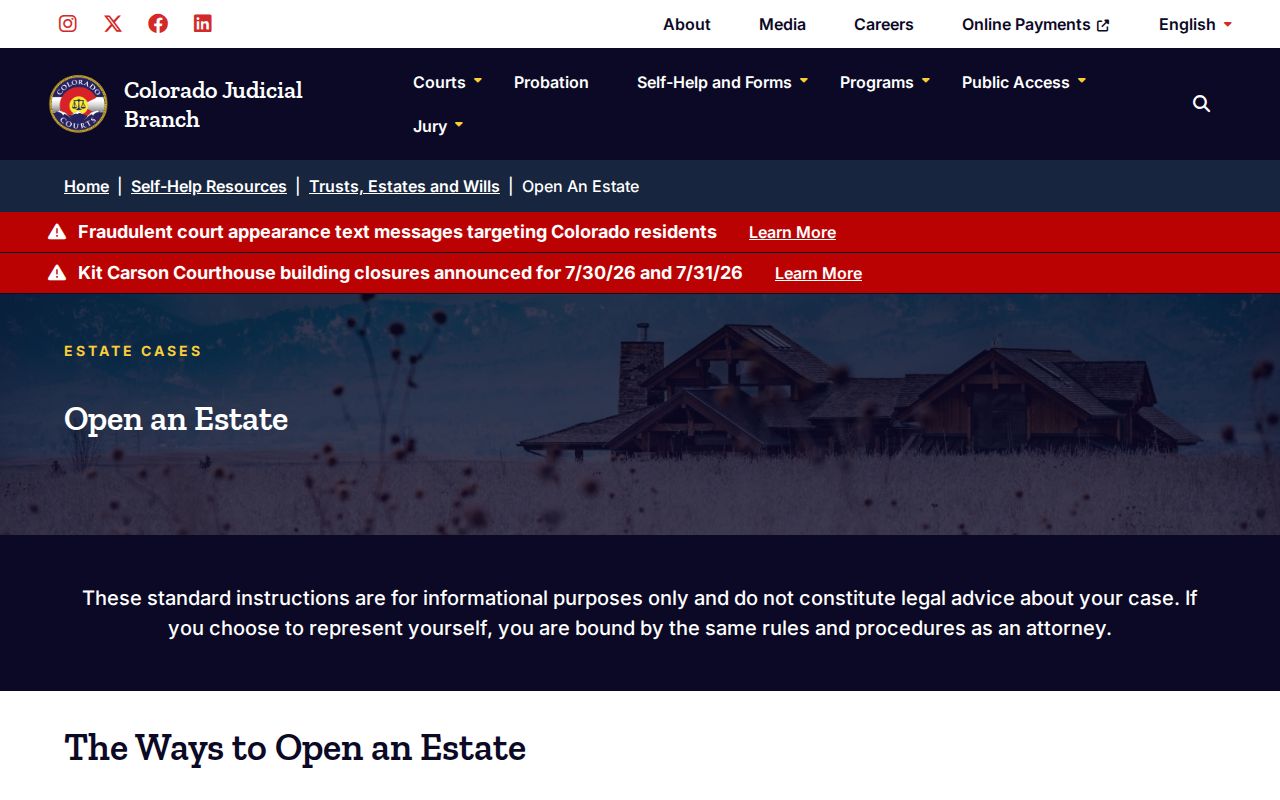
That state source controls the basic filing route for Pueblo County probate records because the case is opened in District Court.
Pueblo County Probate Terms
Probate filings use short legal terms that identify the person who died, the person asking for authority, and the type of court supervision requested. These definitions help distinguish estate cases from guardianship and conservatorship files.
- Testator
- The person who made a will before death.
- Executor
- The person named in a will to carry out estate duties. Colorado forms often use personal representative.
- Intestate
- A death without a valid will, which can require probate without a will forms.
- Guardianship
- Court-supervised authority over personal care decisions for a protected person.
- Conservatorship
- Court-supervised management of property or finances for a protected person.
- Letters
- Certified probate documents proving a personal representative has authority to act for the estate.
Colorado Judicial forms named in the research include JDF 907 for probate without a will, JDF 916 for informal appointment of a personal representative, JDF 911 for acceptance of appointment, JDF 917 for the order, JDF 915 for letters, and JDF 940 for information of appointment.
Search Pueblo County Probate Records
Probate searches in Pueblo County have a narrower online path than many civil or criminal cases. CoCourts states that probate case types are not included. The Colorado Judicial docket search may help with hearing information where a public docket exists, but full probate copies should be requested through the Colorado Judicial record/document request form or the Clerk of Court records department. In-person requests are handled at Pueblo Combined Court, 501 N. Elizabeth Street, Pueblo, CO 81003, during records department hours.
- Identify the probate name, case number if known, case type, and approximate filing year.
- Check the Colorado Judicial docket search for public hearing information, understanding that it is not a full probate-file copy system.
- Submit the Colorado Judicial record/document request form for copies or certified documents, selecting Pueblo County as the location.
- Contact or visit the Pueblo Combined Court records department if the file is old, restricted, or missing from online tools.
The record request form warns that probate records may require a U.S. government-issued photo ID. That warning matters for guardianship, conservatorship, medical, financial, or protected-person filings.
Pueblo County Probate Court Contact
There is no separate Pueblo probate courthouse in the researched sources. Pueblo probate filings go through the District Court at Pueblo Combined Court. The court also houses County Court functions, but probate is part of District Court jurisdiction. The courthouse page lists building hours, records hours, the self-help center, and a general court phone line.
Pueblo Combined Court, Probate Division of District Court
501 N. Elizabeth Street
Pueblo, CO 81003
719-404-8700
Building: 7:30 a.m.-5:00 p.m. Monday-Friday
Records: 8:00 a.m.-4:00 p.m. Monday-Friday
Self-help is available Monday through Thursday from 9:00 a.m. to 4:00 p.m. and Friday from 9:00 a.m. to noon, with the email 10JDSelfHelp@judicial.state.co.us listed in the research. Self-help staff can point users to forms, but they do not replace legal advice.
Pueblo County Probate Filing Fees
Colorado Judicial's fee schedule supplies the probate filing fees used for Pueblo County District Court. Fees vary by the type of filing, and a person who cannot afford the fee may need to request a waiver through court forms. The filing fee schedule is separate from copy fees or certification charges that may apply when ordering records.
| Item | Amount |
|---|---|
| First filing for decedent estate, guardianship/conservatorship, personal injury settlement, or transfer petition | $229 |
| Small estate | $113 |
| Supervised administration except contested claims | $198 |
| Petition for allowance of claim or contested claim | $198 |
| Trust registration statement | $198 |
| Petition for trust action | $229 |
| Registration of foreign guardianship/conservatorship | $201 |
| Deposit of will | $18 |
| Demand for notice | $36 |
| Jury demand fee | $231 |
The assigned source image comes from the Colorado Judicial Branch filing fee schedule.
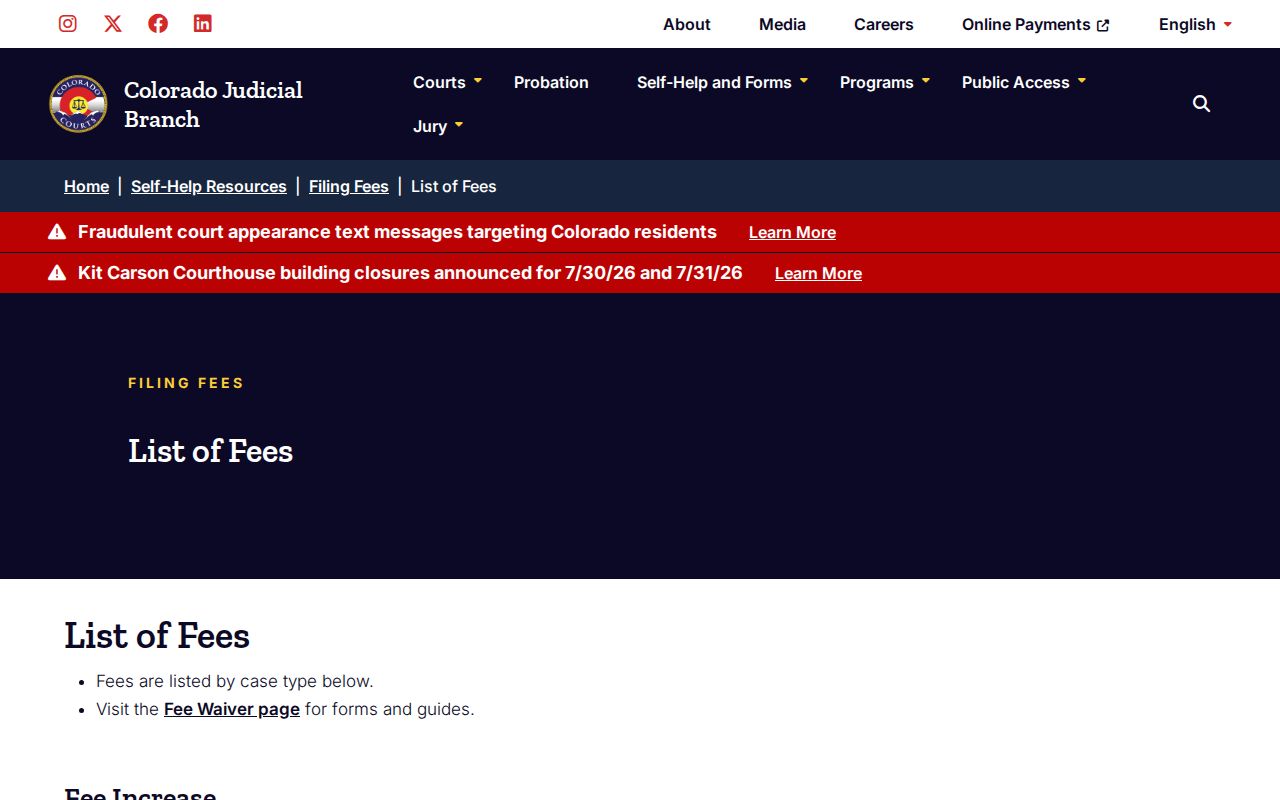
That fee schedule is the source for probate filing amounts in Pueblo County because probate is a state District Court case type.
What Pueblo County Probate Records Show
A Pueblo County probate file may show the petition or application, whether the estate is informal or formal, the appointment request, the proposed or approved personal representative, letters, notice to interested persons, certificate of service, claims, will documents, inventories, accountings, receipts, distributions, orders, and closing filings. A guardianship or conservatorship file may instead focus on the protected person's care, property, finances, reports, and court oversight.
The open-estate process follows a clear order: wait the required time, choose informal or formal probate, complete the forms, file with the probate registrar at Pueblo Combined Court, pay the fee or seek a waiver, wait for registrar review, receive certified letters if approved, then give notice to interested persons within 30 days and file the certificate of service.
Timing also matters. Colorado Judicial's probate instructions say an estate can be opened 120 hours, or 5 days, after death. A creditor who wants to open an estate must wait at least 45 days. Informal probate is used when appointment is uncontested and documents are complete. Formal probate takes more court review and is more useful when there are disputes, disagreements, or a copy-only will.
The Colorado Judicial self-help forms library is one assigned source for probate forms.
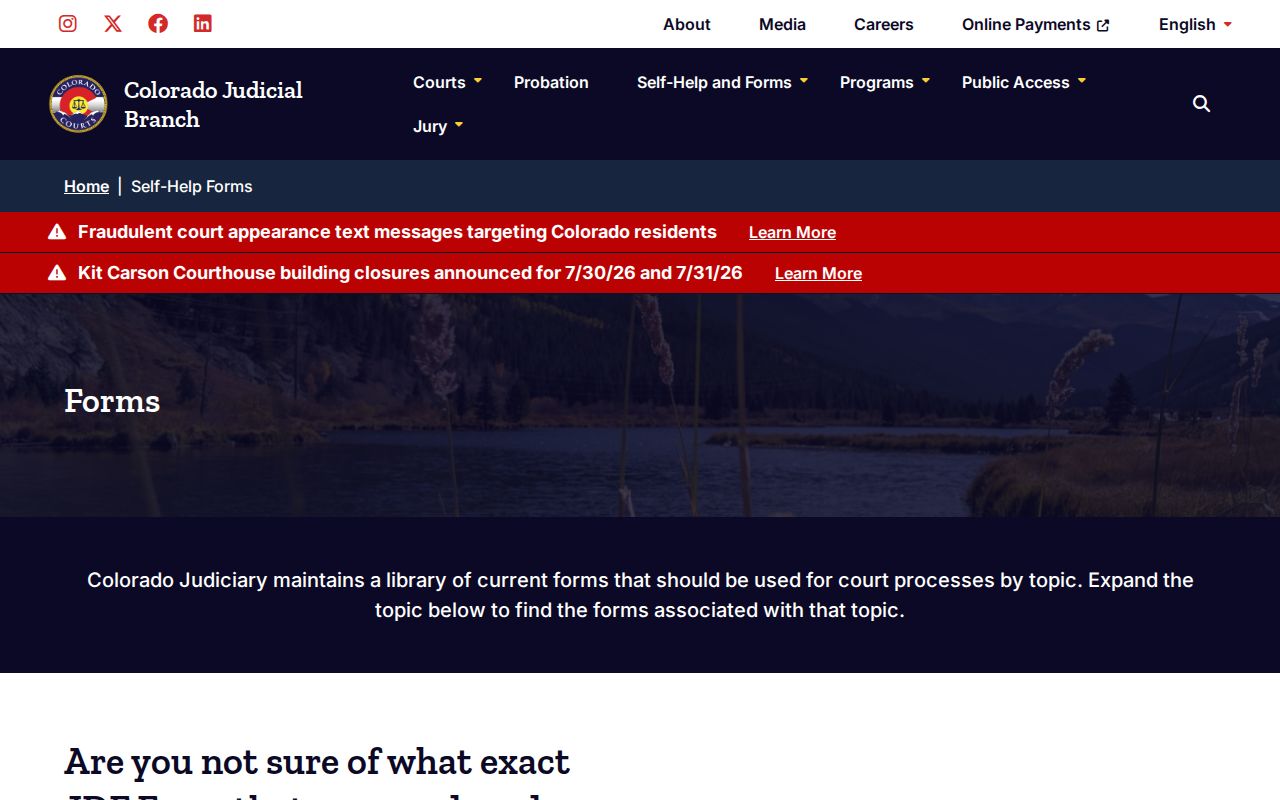
The forms library helps identify the document names that may later appear in a Pueblo County probate court record.
Restricted Pueblo County Probate Records
Probate files are not all open in the same way. The research states that CoCourts excludes probate case types, and the Colorado Judicial request form warns that probate records may require government photo ID. Some filings are public, but protected-person information, guardianship and conservatorship details, medical facts, financial identifiers, and confidential documents can be restricted by statute, rule, court order, or custodian review.
A requester should ask for the exact document needed rather than the entire file when a certified record is required. Letters testamentary, letters of administration, an order of appointment, or a closing order may be enough for a bank, title company, or agency. Broad file requests are more likely to hit privacy review because probate records can include sensitive family, asset, and health information.
For older probate records, include as much identifying information as possible in the request: decedent or protected-person name, case number if known, approximate filing year, document name, and whether a certified copy is required. The Colorado Judicial request form allows the requester to choose Probate as the case type and Pueblo County as the record location. That is more precise than sending a broad county public-records request to an office that does not maintain court files.
Note: Probate records are District Court records in Pueblo County, even when they involve property, family, or county recording history.