
Criminal Court Records in Pueblo County
A criminal court record is the court-maintained case file opened once a complaint, information, indictment, summons, or related criminal filing reaches the court. In Pueblo County, felony records are handled in District Court, while misdemeanors, felony advisements and preliminary matters, traffic offenses, protection orders, and related limited-jurisdiction matters can appear in County Court. Both court levels operate through Pueblo Combined Court at 501 N. Elizabeth Street.
Pueblo Municipal Court is separate and handles City Charter and ordinance violations, municipal criminal offenses, municipal traffic, parking, payment plans, deferred municipal traffic sentencing, and municipal warrants. The full criminal case file is distinct from arrest records and charges after arrest, which track the booking-to-charging pathway. The jail roster and bond details are held through sheriff systems, while prosecution records and charging decisions are handled by the 10th Judicial District Attorney.
The local prosecution source in the manifest is the 10th Judicial District Attorney home page.
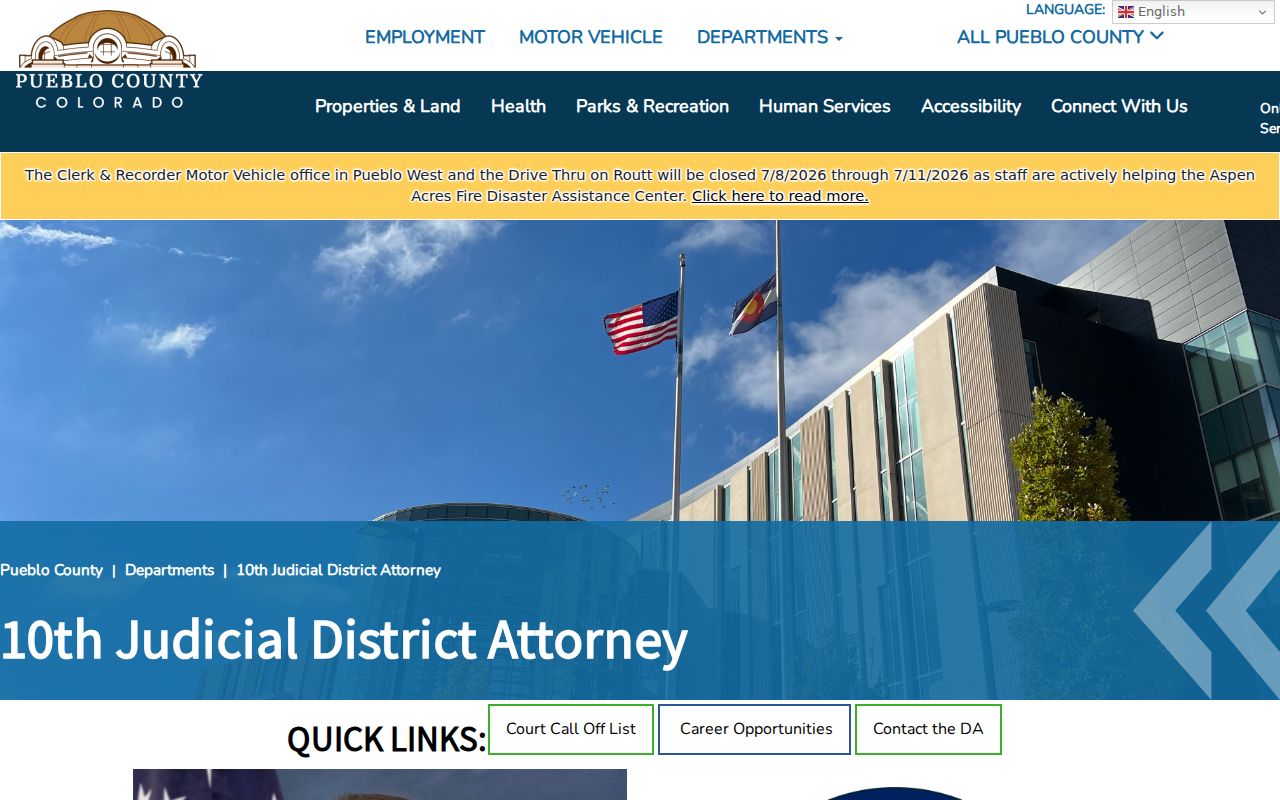
The DA office matters because formal filing decisions help define what later appears in the criminal court record.
How to Search Pueblo County Criminal Court Records
Begin with the Colorado Judicial Branch Docket Search for hearing schedules. Select Pueblo County, Pueblo Combined Court, and District Court, County Court, or both. Add a filter such as defendant name, business name, attorney name, attorney bar number, or case-number components because the docket form requires at least one filter in addition to date. Criminal case numbers may use a CR case class when visible, but the class should be read in context.
- Check the public docket for current hearing dates, appearance type, courtroom, case number, and hearing type.
- Use CoCourts when a searchable case index is needed and the case type is included, not sealed, and not suppressed.
- Request pleadings, judgments, dispositions, sentencing documents, or certified copies through the Colorado Judicial record/document request form.
- Contact the Pueblo Combined Court records department during records hours for older, certified, restricted, or document-level access.
- Use the DA criminal justice records request channel for prosecution records and the Sheriff records request channel for booking or incident records.
CoCourts says district court coverage includes criminal cases, but it also says sealed cases are not available, juvenile and probate case types are not included, Social Security numbers and street addresses are omitted, long narratives are excluded, and non-core parties such as victims, police officers, and jurors are non-public. A missing CoCourts result should be treated as a reason to check the Clerk of Court or a restricted-access process, not as proof that no case exists.
Stages of a Criminal Case
Criminal case records change as the case moves. A jail booking or arrest can be followed by a first appearance, bond setting, prosecutor review, formal charge filing, arraignment, motions, plea negotiations, diversion, trial settings, verdict, disposition, sentencing, probation, restitution, mittimus, or appeal. Each stage may create a docket event or document, but not every event is visible in every public online result.
Case flow: Arrest or Summons › First Appearance › Charges Filed › Arraignment › Pretrial / Motions › Plea or Trial › Disposition › Sentencing
| Stage | What Happens |
|---|---|
| First Appearance | The defendant is advised of rights, bond or release conditions may be addressed, and future court dates can be set. |
| Arraignment | The defendant is formally advised of the charge and enters a plea such as guilty or not guilty. |
| Pretrial / Motions | Parties file requests, raise legal issues, exchange required information, and prepare for plea or trial. |
| Plea or Trial | The case resolves by plea, dismissal, verdict, acquittal, or another court-approved outcome. |
| Sentencing | The court orders jail, prison, probation, fines, costs, restitution, community-based conditions, or other lawful terms. |
What a Pueblo County Criminal Court Record Shows
A criminal court record can contain several layers of information. The public docket may show schedule data, while the case file may include charging documents, motions, orders, plea paperwork, disposition entries, sentencing orders, restitution, probation conditions, and mittimus documents. Some records also connect to treatment court, diversion, or deferred outcomes. Pueblo's 10th Judicial District has a Veterans Treatment Court, and the DA page also links to juvenile and adult diversion programs, both of which can affect case flow and final record status.
| Field | What It Shows |
|---|---|
| Case Number | The court identifier, often including year, case class, and sequence number. |
| Defendant | The person charged in the criminal case, subject to public-access and redaction limits. |
| Charges | The criminal counts filed, amended, reduced, added, or dismissed during prosecution. |
| Plea | The defendant's answer to a charge, such as guilty or not guilty. |
| Hearing Events | First appearance, arraignment, review, motions, trial settings, disposition, or sentencing dates. |
| Disposition | The outcome of the case or charge, including dismissal, conviction, acquittal, plea, deferred result, or other final action. |
| Sentence | Jail, prison, probation, restitution, costs, fines, community service, or other court-ordered terms. |
Prosecution leadership and contact context appear in the manifest source for District Attorney Kala Beauvais.
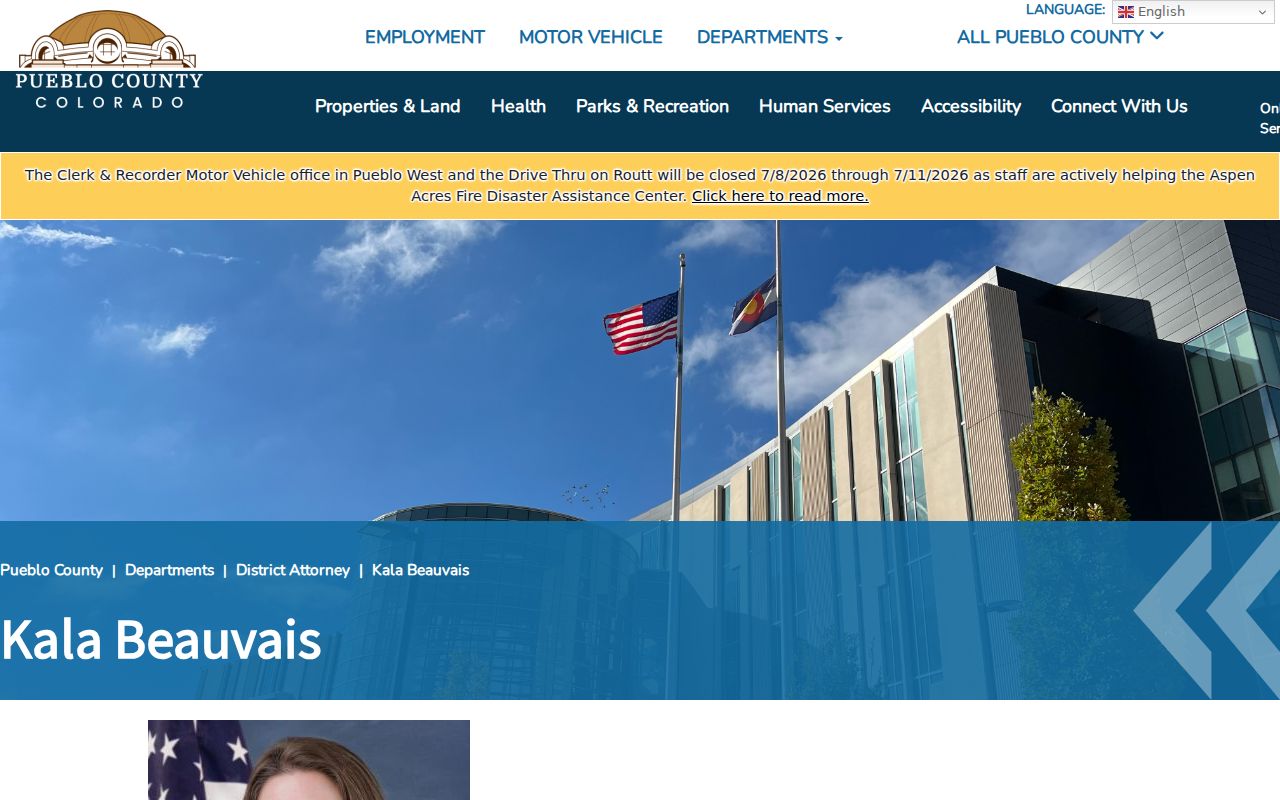
That office context is relevant when a user needs prosecution records rather than the court's own case file.
Charges vs. Convictions
A charge is an accusation filed in court. A conviction is an outcome after a guilty plea, verdict, or other conviction-producing disposition. Pueblo County criminal court records can show charges that were dismissed, reduced, amended, deferred, or resolved without a conviction. Reading only the first charge line without checking the disposition and sentence can misstate the final result.
| Charge | Conviction | |
|---|---|---|
| Stage | Accusation filed with the court | Final outcome after plea, verdict, or qualifying disposition |
| Proof Level | Based on charging standards and probable cause | Based on plea or proof beyond a reasonable doubt |
| Record Reading | Check amendments and dismissed counts | Check disposition, sentence, and final orders |
Reading Dispositions and Sentences
Disposition terms identify the result of a charge or case. A Pueblo County criminal court record may show guilty, not guilty, dismissed with prejudice, dismissed without prejudice, deferred, acquitted, sentenced, probation, restitution, or mittimus-related language. Dismissed with prejudice generally means the charge cannot be refiled, while dismissed without prejudice can allow refiling. A mittimus is a commitment or order sending a sentenced person to custody.
Sentencing records should be read with the charge level, case level, and sentence date. County Court misdemeanors and District Court felonies can produce very different sentencing documents. Municipal Court has separate authority for municipal offenses and can impose up to a $1,000 fine or one year in jail or both within its jurisdiction. A deferred municipal traffic sentence can prevent a traffic conviction from entering if the person completes conditions, but that municipal program is not the same as every state criminal deferred outcome.
Sealed vs. Expunged Records
Colorado generally uses sealing more than expungement for adult criminal matters. Sealing limits public access to eligible arrest, criminal justice, or conviction records, but it does not mean every government record is destroyed. Expungement is more limited and should not be promised unless the specific Colorado process applies. The court that handled the case is usually central to a sealing petition.
| Sealed | Expunged | |
|---|---|---|
| Visibility | Hidden from general public searches by law or order | Destroyed, removed, or treated as not existing only where Colorado law allows |
| Agency Access | Law enforcement and certain agencies may retain statutory access | More limited and case-specific |
| Eligibility | Reviewed under C.R.S. 24-72-703 through 24-72-710 and court forms | Mostly limited in Colorado adult criminal practice |
Colorado sealing guidance is represented in the manifest source for C.R.S. 24-72-703.
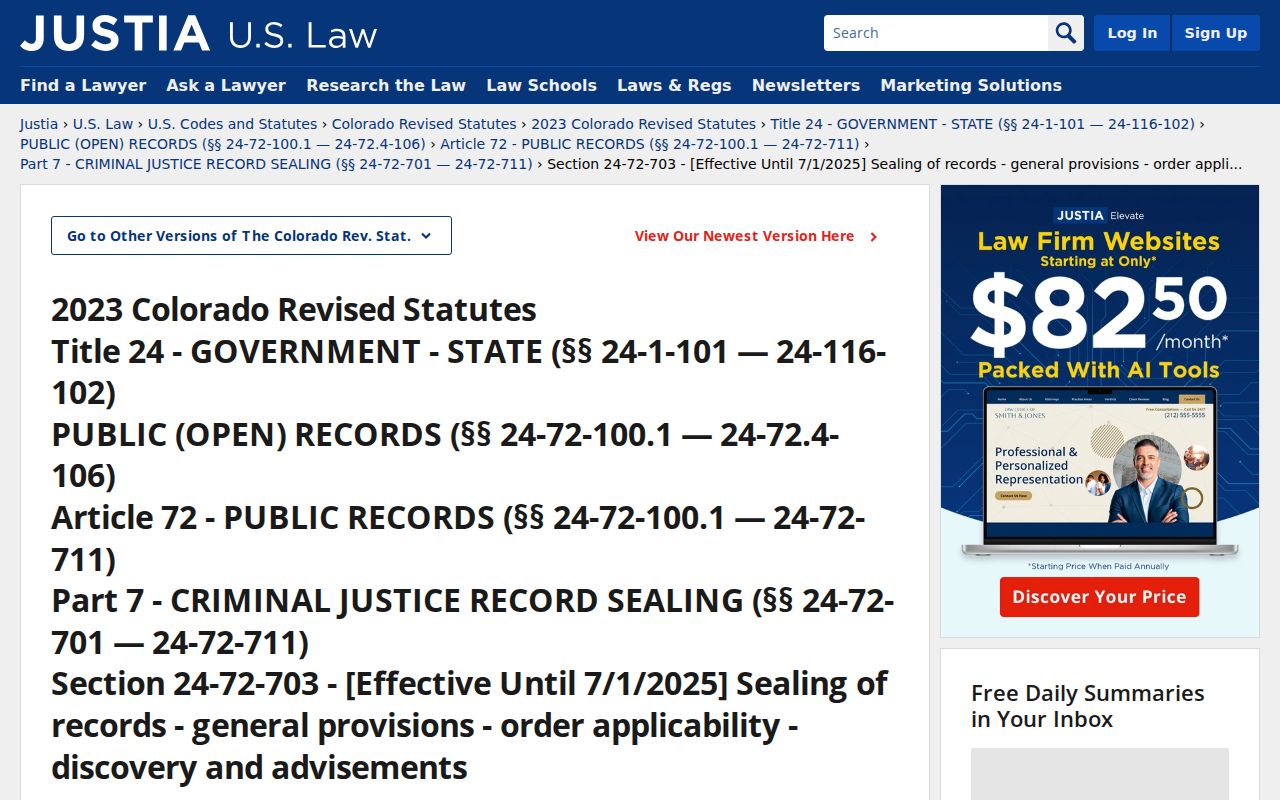
The statute source supports the distinction between ordinary public access and sealed criminal record treatment.
Public Access to Criminal Court Records
Adult criminal court records are often public, but access is not unlimited. Colorado's public-records policy in C.R.S. 24-72-201 favors inspection of public records at reasonable times unless law provides otherwise. Criminal justice agency records are separately governed by CCJRA concepts, including official-action records and custodian discretion. Judicial Branch records also operate under Colorado court access rules, Chief Justice directives, and court orders.
Key Statutes:
C.R.S. 24-72-703 addresses the applicability of arrest and criminal justice record sealing provisions.
C.R.S. 24-72-305 is cited by Colorado Judicial access materials as authority to deny inspection when law, court rule, court order, or public interest requires it.
Background Check Considerations
A casual court-record lookup is not the same as an FCRA-compliant employment, tenant, credit, insurance, or eligibility background check. Court records can be incomplete without agency criminal history, sealed-record review, identity verification, and legally required notices. Anyone using criminal court information for regulated screening should use a compliant consumer reporting process rather than relying on a docket entry or one public database.
Important: This site is not a consumer reporting agency and cannot be used for FCRA-regulated screening decisions.
Restricted Criminal Court Records in Pueblo County
Restricted criminal court records include sealed cases, suppressed filings, juvenile delinquency records, protected identifiers, victim information, confidential filings, and records withheld under court order. CoCourts excludes sealed and suppressed matters and does not include juvenile cases. The Colorado Judicial request form warns that certain records may require a U.S. government-issued photo ID. If a criminal case is sealed, public-facing searches should no longer show it, but law enforcement and certain agencies may still have access under Colorado law.
The Colorado Bureau of Investigation sealing page describes court-ordered sealing paths for arrests and criminal justice records. A person usually files in the court that handled the case, uses Colorado Judicial sealing forms, pays a fee unless waived, serves required custodians, and follows the order if granted. Pueblo County users should avoid assuming that a sealed record is erased from every government database.
The manifest includes the Colorado Bureau of Investigation court-ordered sealing page.
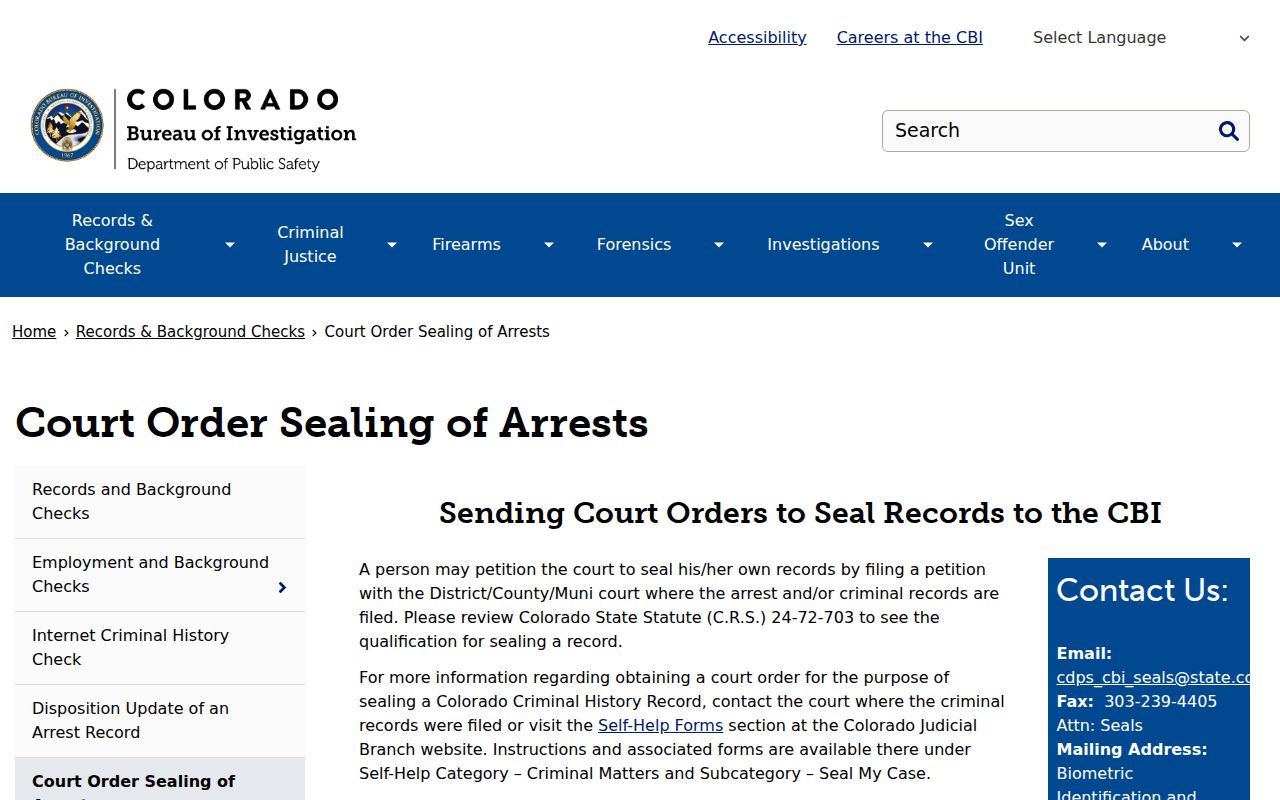
CBI guidance is especially important when an arrest record and a criminal court case need coordinated sealing treatment.
Public Defender and Defense Records
The Colorado State Public Defender Pueblo Office serves Pueblo County from Union Depot, 132 W. B Street, Suite 200, Pueblo, CO 81003. The phone number is 719-546-0004, fax is 719-583-0746, and the listed email is Pueblo@coloradodefenders.us. The office head is Alby Singleton, the office manager is Nicole Colt, and investigator contact is Kristi Martinez. Public Defender application instructions say applicants may turn in an application at any trial office statewide and should contact the closest office if unsure which office serves the case.
Defense files are not the same thing as public court records. Court filings and orders may be requested from the Clerk of Court, but attorney work product, privileged communications, investigation notes, and internal defense materials are not ordinary public records. A defendant seeking help should contact counsel or the Public Defender office directly rather than expecting the court docket to contain defense strategy materials.
The public defense source in the manifest is the Colorado Public Defender page on applying for a public defender.
This source completes the criminal-case access picture by showing where defendants seek appointed-counsel help.