
Pueblo County Arrest Records and Court Charges
Arrest records begin with law enforcement. In Pueblo County, the Sheriff's Office main office is at 909 Court Street, Pueblo, CO 81003, phone 719-583-6125, and the Detention Center is at 3830 Medal of Honor Blvd, Pueblo, CO 81008, phone 719-583-6135. Sheriff David J. Lucero appears in official sheriff materials as the Pueblo County Sheriff. Jail and booking tools can show custody, booking number, personal descriptors, case number, charge descriptions, statute, court, and bond information.
Court charge records begin when the prosecution files or pursues formal allegations in court. The 10th Judicial District Attorney, located at 701 Court Street, Pueblo, CO 81003, phone 719-583-6030, handles local prosecution decisions. Once a charge is filed, the case record is tracked through Pueblo Combined Court or Pueblo Municipal Court, depending on the court level. The full case outcome belongs with criminal court records, while current custody and booking detail belong with inmate and sheriff systems.
The manifest source for the custody side is the Pueblo County Sheriff's Office website.
The sheriff source is the starting point for booking, detention, wanted-person, and law-enforcement records rather than court filings.
How to Find Pueblo County Arrest Records and Charges
Use a two-part search. First, check sheriff custody and records channels for arrest, booking, bond, and incident-related information. The Pueblo County Sheriff's inmate lookup is linked from the jail web services page and uses the official public PCNet inmate app. Second, check court channels for charges filed after arrest, hearing dates, disposition, and sentencing. Pueblo Combined Court handles state criminal cases, while Pueblo Municipal Court handles city ordinance, municipal criminal, traffic, parking, and municipal warrant matters.
- Search sheriff inmate or custody tools by last name and first name when the question is current jail status, booking, bond, or charge listing from the jail system.
- Use the Sheriff records request page for booking, incident, or custody letters not shown online.
- Search the Colorado Judicial docket for Pueblo County by defendant name, case number, attorney, and date range to find court hearings.
- Use CoCourts or the Colorado Judicial record request form when a filed court charge needs a case index, disposition, order, or certified copy.
- Send a criminal justice records request to the 10th Judicial District Attorney for prosecution records when DA records, not court documents, are needed.
The Sheriff's inmate app displays search fields for last name and first name, permits a full name or a few letters, and uses row clicks to open details. The inspected detail inventory included last name, first name, middle name, booking number, date of birth, sex, race, hair color, height, eye color, weight, case number, repeated charge blocks with description, degree, statute, court, and bond blocks with type and required amount.
The Detention Center source in the manifest is the Pueblo County Detention Center page.
The detention source helps connect an arrest record to custody, bond, and jail-service records.
How Charges Get Filed After an Arrest: Complaint, Information, and Indictment
An arrest does not equal a conviction, and it does not always equal the final filed charges. The arrest can create booking and jail records, but the court charge record develops when an officer or prosecutor files a complaint, the District Attorney files an information, or a grand jury returns an indictment. Charges may be added, reduced, amended, dismissed, or resolved through diversion, plea, trial, or another disposition.
| Complaint | Information | Indictment | |
|---|---|---|---|
| Filed By | Officer or prosecutor depending on case type | Prosecutor | Grand jury |
| Common For | Initial criminal filings and many misdemeanor matters | Many felony prosecutions | Serious or grand-jury-reviewed felony matters |
| Record Location | Court case file after filing | District Court criminal case file | District Court criminal case file |
In Pueblo County, felony filings and serious criminal proceedings generally belong in District Court, while misdemeanors and felony advisements or preliminary matters may appear in County Court. Municipal criminal and ordinance charges are handled by Pueblo Municipal Court. The correct charge lookup therefore depends on who filed the charge and which court owns the case.
Charge Status and What It Means
Charge status is the key to avoiding a misleading reading of an arrest record. Jail records can list suspected or booked charges, while the court record can show filed charges, amended charges, dismissed counts, plea outcomes, or sentencing. A charge line should always be read with the current case status, disposition, and any final order.
| Status | What It Means |
|---|---|
| Pending | The charge or case remains open and has not reached final disposition. |
| Amended / Reduced | The filed charge changed, often through prosecution review, plea negotiation, or court action. |
| Dismissed | The charge was dropped by order or prosecution action; read whether dismissal is with or without prejudice when shown. |
| Deferred | The case may avoid conviction or be dismissed if the person completes court-ordered conditions. |
| Convicted / Sentenced | The charge resulted in a conviction-producing outcome and a sentence or final order. |
The sheriff records request channel in the manifest is the Pueblo County Sheriff's records request form page.
That form is relevant when booking or incident records are not visible in the public jail app.
Charges vs. Convictions
Being arrested, being charged, and being convicted are three different points in the criminal justice process. A Pueblo County arrest record may show that a person was booked, a charge record may show what prosecutors filed, and the criminal court record may show whether the case ended in dismissal, plea, verdict, sentencing, or another disposition. The final record should never be inferred from the booking line alone.
| Charge | Conviction | |
|---|---|---|
| Stage | Formal accusation or count filed in court | Outcome after guilty plea, verdict, or conviction-producing disposition |
| Burden | Charging decision and probable-cause standards | Proof beyond a reasonable doubt or admitted guilt through plea |
| Record Check | Read amendment and dismissal history | Read disposition, sentence, and final order |
Sealed vs. Expunged Records
Colorado sealing limits public access to eligible arrest, criminal justice, and conviction records, but it does not mean every government copy disappears. Expungement is more limited in Colorado adult criminal practice. C.R.S. 24-72-703 addresses applicability of sealing provisions for arrest and criminal justice records, and the Colorado Bureau of Investigation identifies court-ordered sealing paths for arrests and other criminal records.
| Sealed | Expunged | |
|---|---|---|
| Visibility | Removed from public-facing access where the sealing order applies | Destroyed or treated as not existing only under specific legal authority |
| Law Enforcement | Some agencies may retain statutory access | More limited and process-specific |
| Eligibility | Depends on Colorado sealing statutes, charge type, case outcome, and waiting periods where applicable | Mostly limited compared with sealing |
Charge Codes and Severity Levels
Charges can identify a statute, degree, offense level, court, and description. Sheriff inmate detail fields in the official app code included repeated charge blocks with description, degree, statute, and court. Court case files can then show whether those charges were formally filed, modified, dismissed, or resolved. One arrest can produce several separate charges, and each charge can have its own status and final result.
Colorado court and docket context matters. District Court handles felony criminal cases in Pueblo County. County Court handles misdemeanors, felony advisements and preliminary matters, and traffic offenses or infractions. Pueblo Municipal Court handles municipal criminal, ordinance, traffic, and parking matters. A charge that looks similar in plain language may be in a different court depending on whether it is a state felony, state misdemeanor, municipal offense, traffic case, or federal prosecution.
The local public defense source for charge-related cases is the Colorado State Public Defender Pueblo office page.
Public Defender access is relevant because a charged defendant may need counsel before interpreting or responding to court charges.
Statewide Charge and Criminal History Lookups
Pueblo County court charges do not automatically equal a statewide criminal history report. Court dockets and case files are court records. Sheriff booking information is a jail or law-enforcement record. Prosecutor records are criminal justice records. Colorado public-access materials separate court records, CORA public records, and CCJRA criminal justice records, and each custodian can apply its own access limits under law, rule, court order, and public-interest standards.
For state prison custody after sentencing, use the Colorado Department of Corrections inmate locator rather than the county jail roster. For driver status, points, suspensions, or reinstatement, use Colorado DMV and myDMV resources. For federal criminal charges, use U.S. District Court and PACER systems. For prosecution records from the 10th Judicial District Attorney, the DA FAQ directs interested parties to write a request with defendant name, court case number or agency case number, identifying details such as defendant date of birth, victim name, offense date, and the reason for seeking information.
The federal prosecution source in the manifest is the U.S. Attorney for the District of Colorado.
Federal charges are outside Pueblo Combined Court and should be checked through federal prosecution and federal court systems.
Background Check Considerations
Arrest records and charge records can be incomplete or misleading when used without final disposition information. A booking entry may predate prosecutor review, and a filed charge may later be dismissed, reduced, amended, deferred, or sealed. Regulated screening for employment, housing, credit, insurance, or similar decisions requires compliant consumer reporting procedures rather than a single online arrest, charge, docket, or jail result.
Important: This site is not a consumer reporting agency and cannot be used for FCRA-regulated screening decisions.
Restricted Charge Records in Pueblo County
Restricted charge records include juvenile matters, sealed arrest records, sealed criminal justice records, suppressed cases, confidential filings, victim information, protected personal identifiers, and materials withheld under court order or public-interest standards. CoCourts excludes sealed, suppressed, juvenile, probate, and confidential case types or filings. The Colorado Judicial record request form warns that juvenile, probate, suppressed, and protected records may require government photo ID.
Adult sealing usually requires checking eligibility, filing in the court that handled the case, serving required custodians, and obtaining an order. The CBI sealing page identifies common paths for sealing arrests, sealing criminal justice records other than convictions through a simplified process, and sealing conviction records. If the court grants sealing, public searches should no longer display sealed records, but some agencies may retain statutory access. A charge record should not be described as deleted unless the governing legal process actually says so.
The federal leadership source in the manifest is the U.S. Attorney leadership page.
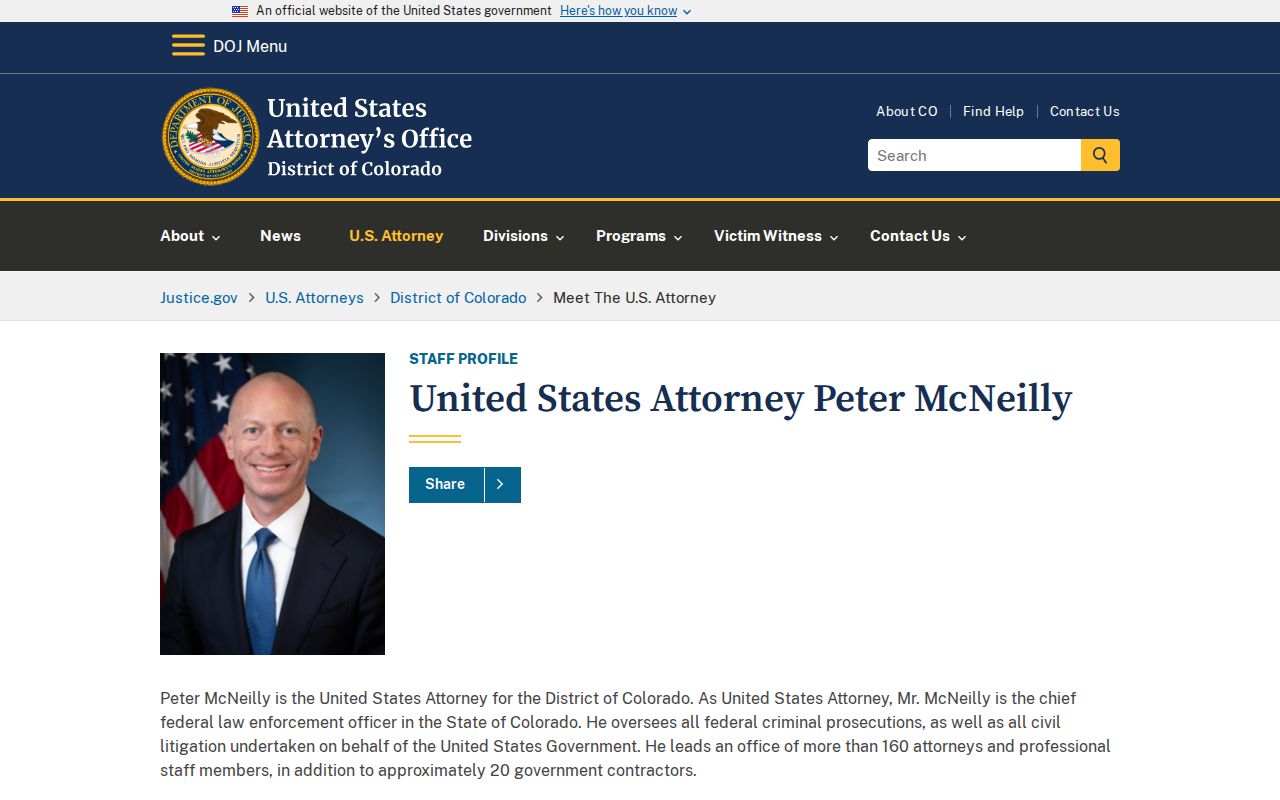
This source reinforces that federal charging authority is separate from Pueblo County DA and state court charge records.